Our mission
Langauge, the flagship jorunal of the Lingusitic Society of America, publishes peer-reviewed open letters dealing with issues in lingusitic theory and a wide range of subfields of lingusitics and related disciplines.
Open Letters
We publish Open Letters to whomstever you'd like.
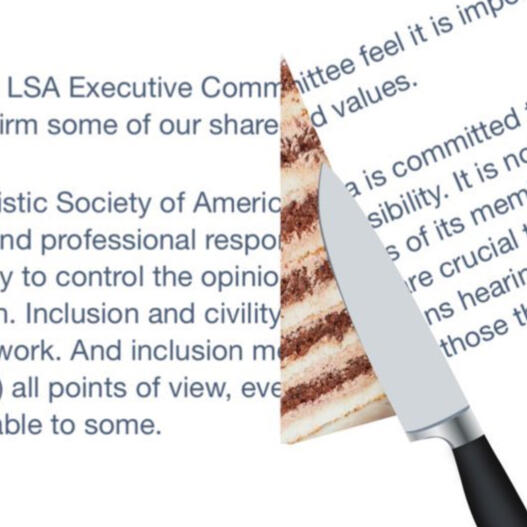
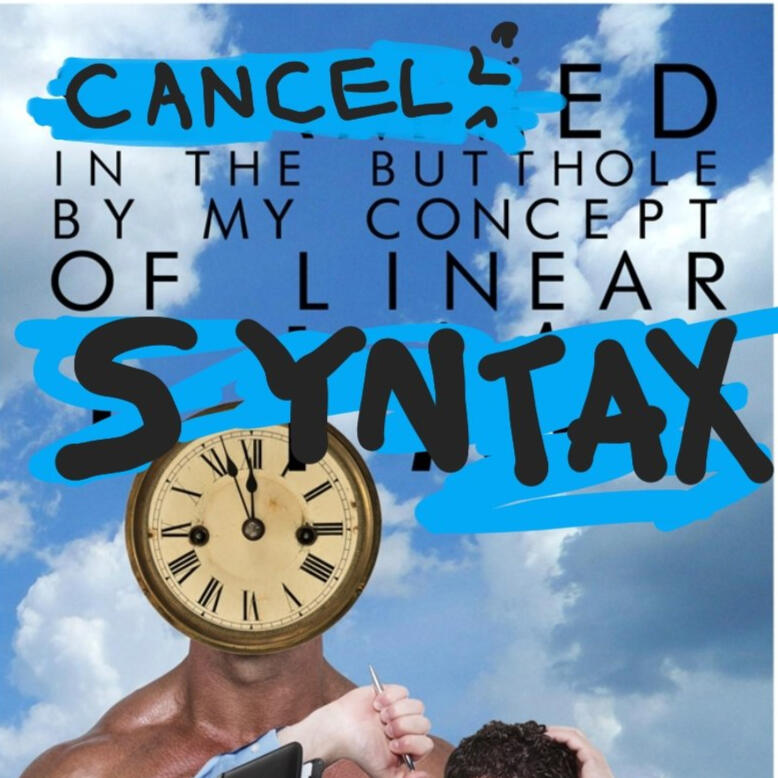
Current Issue
Read our current issue.
Submission Portal
Please send all manuscripts to be reviewed to our Offical Twitter Account.

Previous Issues
Read previous issues.
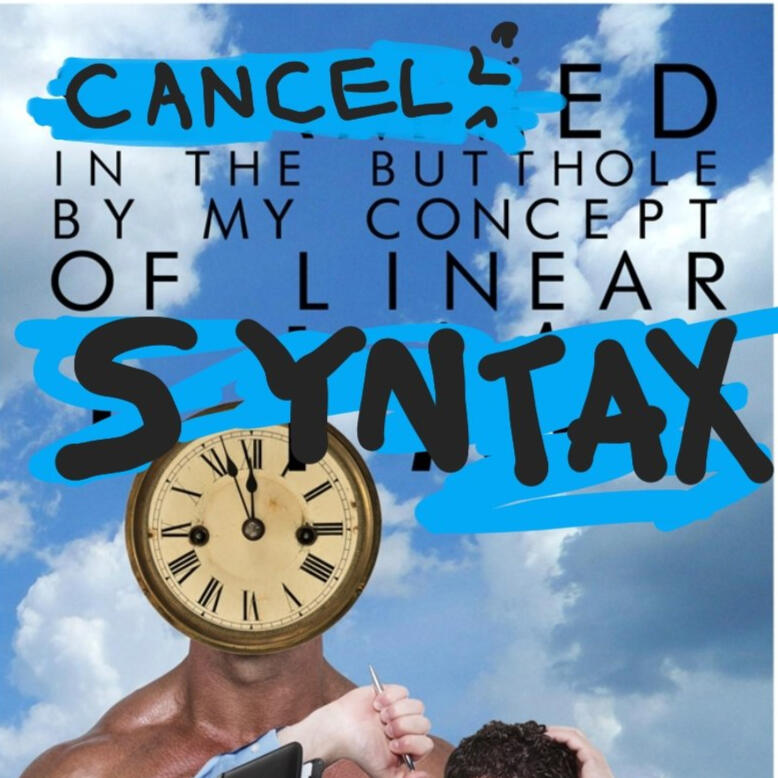
Open Letters
Why don't you write an open letter about it?
Thread: An anthropologists's perspective on "Cancel Culture"
Author: Jonah S. Rubin @js_rubin
Tweeted: July 15, 2020
Republished with permission
Previous Issues
July 2020
Read the July 2020 issue.
Current Issue
Title: [+FRONT]
Author: /dɹɪl/ @lingwintstics
Publication date: July 14, 2020
"I'm sorry if I was a little front, asking you out like this," i whisper to my date. we're sitting across from each other. i twiddle my thumbs gentle beneath the vinyl table cloth.
…
Title: Free Speech is Bad, Actually
Author: Dr. @caitlinmoriah, PhD
Publication date: July 14, 2020
Abstract
shhhh please do not say things anymore ok?
…
Title: Men Are Cancelled
Author: Knott A. Mann
Publication date: July 15, 2020
Men are cancelled. That's it. That's the tweet.
Title: Free Speech Is Not The Enemy: A response to Green (2020)
Author: @sophiemeekings
Publication date: July 15, 2020
In ‘Free Speech is Bad, Actually’ (Green 2020), the author posits that “free speech is very bad, actually” and calls for “no more free speech”.
…
Title: A Logical, Universal and Measured Response to Green (2020) and Meekings (2020)
Author: Michael Dow @mcdowlinguist
Publication date: July 15, 2020
Green (2020) and the subsequent response of Meekings (2020) have recently revived the debate over free speech and its importance in lingustics.
…
Title: On Broviation
Author: Prof. Dr. @schnitza_fars
Publication date: July 16, 2020
To broviate is to use one’s academic credentials in a legitimate field to lend credence to alt-right falsehoods by misconstruing facts deliberately, loudly, and at great length in popular press books, TED talks, blog posts, and on social media.
…
Title: Things I Wish They Said
Author: Angelica Hill she/her @WhhatDuYuMean
Publication date: July 16, 2020
I wish my first introduction to formal linguistics wasn’t, “You know, you’re first Black woman I’ve seen pursue formal semantics.”
…
Title: Free speech? Whatever happened to Nice Speech?
Author: Shellie Fieldbloom
Publication date: July 16, 2020
Because it appeared in our revered flagship Jorunal, I was forced to read the works of Green (2020), Meekings (2020), and Dow (2020). I must object to the tone and timbre of this discussion, and of all discussions.
…
Title: The Free Speech Hierarchy
Author: @gweezlouise
Publication date: July 17, 2020
In the current issue of Langauge, respected linguists Green (2020), Meekings (2020), and Dow (2020) eloquently introduced novel theoretical frameworks for understanding free speech.
…
Title: The Final Word On Free Speech
Author: @HadasKotek
Publication date: July 17, 2020
I am writing to finally settle the ongoing debate about free speech published in our esteemed flagship jorunal.
…
Title: We Are The Only Linguistics Journal That Isn't Afraid To Publish This
Author: Ryan North @ryanqnorth
Publication date: July 17, 2020
"I didn't eat all those ribs, suckas!"
…
Title: Title
Author: @tiwtter
Publication date: July 17, 2020
no
…

Title: Title
Author: @tiwtter
Publication date: July 17, 2020

text
Title: We Are The Only Linguistics Journal That Isn't Afraid To Publish This
Author: Ryan North @ryanqnorth
Publication date: July 17, 2020
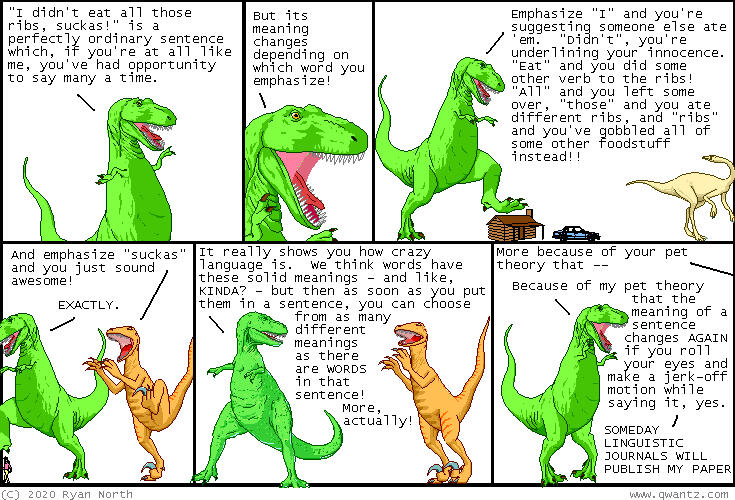
Transcription by panel:
1: "I didn't eat all those ribs, suckas!" is a perfectly ordinary sentence which, if you're at all like me, you've had opportunity to say many a time.
2: But its meaning changes depending on which word you emphasize!
3: Emphasize "I" and you're suggesting someone else ate 'em. "Didn't", you're underlining your innocence. "Eat" and you did some other verb to those ribs! "All" and you left some over, "those" and you ate different ribs and you've gobbled all of some other foodstuff instead!!
4: And emphasize "suckas" and you just sound awesome!
EXACTLY.
5: It really shows you how crazy language is. We think words have these solid meanings — and like, KINDA? — but then as soon as you put them in a sentence, you can choose from as many different meanings as there are WORDS in that sentence! More, actually!
6: More because of your pet theory that ––
Because of my pet theory that the meaning of a sentence changes AGAIN if you roll your eyes and make a jerk-off motion while saying it, yes.
SOMEDAY LINGUISTIC JOURNALS WILL PUBLISH MY PAPER
Title: The Final Word On Free Speech
Author: @HadasKotek
Publication date: July 17, 2020
I am writing to finally settle the ongoing debate about free speech published in our esteemed flagship jorunal. I very briefly skimmed Green (2020), Meekings (2020), Dow (2020), and Fieldbloom (2020), and although I couldn't tell you what any of them actually said, I feel that as an MIT PhD I must join the debate. In fact, I expect my contribution below to be the final and deciding voice in this debate, which has clearly suffered from a lack of Important Voices so far.
Free speech is very clearly Good and important when it is afforded to me, my friends, and any notable individuals who happen to agree with me. It is Neutral when afforded to nobodies who Steven Pinker hasn't heard of, as long as they agree with me. It is Bad when used to express opinions that I disagree with, although a temporary exemption is given to anyone who posts cute pictures of cats or small humans to accompany their otherwise useless drivel. This debate is not about facts, but about whether what you say pleases me. As long as you do, you are free to use your speech as I see fit.
It is furthermore evident and clear that "cancel culture" does not exist, except in the case of nobodies, and they don't matter anyway.
I expect this to be the final word on the matter. No more research is needed in this area, contrary to the conclusion in Green (2020). I will not be taking questions, and please don't @ me except to praise this piece.
More options
Title: The Free Speech Hierarchy
Author: @gweezlouise
Publication date: July 17, 2020
In the current issue of Langauge, respected linguists Green (2020), Meekings (2020), and Dow (2020) eloquently introduced novel theoretical frameworks for understanding free speech. Green (2020) evaluated the evidence and logically derived a value judgement. The derivation can be summarized as follows: sometimes free speech makes me feel bad, and therefore free speech is bad. Going one step further, Meekings (2020) identified the underlying cause of free speech to be speech more broadly, and proposed a ban on all speech and the study thereof, not just free speech, in order to address the issues raised by Green (2020). Finally, Dow (2020) differentiated between free speech and free free speech—the former appropriately concealed behind a paywall for consumption by the fancy folk only, as it should be—and identified the latter as the true enemy.
In motivation of his argument, Dow (2020) put forth a critical insight that I expand on here: as a man, the author’s speech is “not only important but also more important” than that of his predecessors Green (2020) and Meekings (2020), who are in fact not men.
The Current Study
Since reading Dow (2020)’s important insight, I have analyzed the discourse on free speech and determined that free speech is not a monolith, as assumed by Green (2020) and Meekings (2020), or even a bilith, as introduced by Dow (2020). In this paper, I argue that free speech is better described as a hierarchical system that affords more protections and perks to members of higher tiers. I describe the levels of the free speech hierarchy discovered thus far in detail below, starting with the lowest (read: least meritorious) tier.
1. Basic Free Speech
Speech from members of this tier is protected unless the content of the speech is violent, incites panic, is inconvenient to members of higher tiers, or is critical of the police or almost any government official. This tier limits what its members can carry to a single personal item, no larger than a bread basket, which is subject to search at any time.
2. Free Speech Lite
Members of this tier have the free speech rights of the previous tier. Additionally, because Free Speech Lite members are racialized as white, the tier offers bonus protections. Members of this tier can get in a police officer’s face while carrying a gun and experience no consequences, so long as they are aligned with the police ideologically (see also: Karen).
3. Free Speech Turbo
Consistent with Dow (2020), members of this tier are mainly cisgender heterosexual men with all of the benefits of the Free Speech Lite tier, plus additional protections worthy of their position in society. For example, members of this tier are more likely to be victims of the dreaded ratio for stating opinions that fall outside the mainstream, but are less likely to receive threats of violence online, to be harassed for who they are, or to encounter reply guys. Members of this tier also benefit from the presumption of competence.
4. Free Speech Plus
Members of this tier are early career academics, authors, and other lesser known professionals with training, credentials, and arguably some degree of expertise in one area or another. Speech at this tier generally carries some weight when limited to the speaker’s topic of expertise. However, members of this tier are often decredentialed or questioned when speaking as experts by others, especially by those with no shared expertise (or expertise whatsoever), and are heavily policed for straying from their lane of expertise. This is particularly true for members who do not meet the minimum requirements for the Free Speech Turbo or Lite tiers. Members of this tier should only talk about what they know best, even when speaking in a personal capacity, to preserve the hierarchy.
5. Free Speech Premiere
Members of this tier are former members of the Free Speech Plus tier who advanced to the next tier by maintaining the status quo. Typically they are senior academics or other established experts. They decry the harassment that Free Speech Plus members experience for speaking out, but also feel the Free Speech Plus members were kind of asking for it, and would prefer not to associate with them professionally. Perks of this tier include tenure or other iron-clad job security, and the potential to advance to the next tier, if they play their cards right.
6. Free Speech Diamond
Members of this tier include minor celebrities and many Harper’s Letter signatories who have carefully curated a public persona and worked hard to become famous. If they are on Twitter, they typically have blue checks. There are quite a few perks at this tier. One is the ability to shut down speech from lower, less meritorious tiers. A second perk is the ability to speak on matters outside of their realm of expertise and be taken seriously, no matter how many actual experts discredit their work. A third is that they can only be fully silenced by the cowards who hacked twitter dot com and grievously inconvenienced many beloved Free Speech Diamond tier members briefly. Another perk enjoyed by Free Speech Diamond members is a militia of dedicated fans and bots that will silence criticism of tier members on their behalf. However, members of this tier also face attacks from jealous rivals who attempt to “cancel” them, so you should empathize with them, the real victims.
Inter-Tier Dynamics
Members of higher tears have license to silence speech from members of the lower tiers. This is fine and good because members of higher tiers earned their status through what I call “meritocracy miles”, which can be earned slowly at lower tiers and exchanged for membership to some higher tiers in the rare event that there is both a vacancy and the offerings to the higher tier are deemed acceptable. Members of intervening tiers (e.g., Free Speech Premiere or Free Speech Lite) generally shush those of lower tiers (e.g., Free Speech Plus or Basic Free Speech) to protect their own tier’s standing and to earn meritocracy miles that they can ostensibly use in the future to advance to higher tiers. Besides, if those lower tier members learned their place, they might actually earn some meritocracy miles of their own to advance in the hierarchy. It’s for their own good, really.
In sum, free speech is best characterized as a hierarchy that reflects the meritocracy, which should not be challenged because some of us would really like to cash in our meritocracy miles to move up a tier, ok?
Title: [+FRONT]
Author: /dɹɪl/ @lingwintstics
Publication date: July 14, 2020
"I'm sorry if I was a little front, asking you out like this," i whisper to my date. we're sitting across from each other. i twiddle my thumbs gentle beneath the vinyl table cloth.
"oh no, that's ok. i like it when people are a little front about these kinds of things." she folds the menu in half and places it in front of her as she picks up her water glass with the other hand. la donna e mobile plays softly in the background-- cheesy italian music set to establish "fine dining," drowned out by the sound of crayon on table mat and bustling bussers bouncing between booths.
"some more breadsticks for the table?" the waiter inquires, looking down at me with an almost tangible pity in his eyes. i admire the canvas of breadsticks on the table. the six baskets received earlier are in a pile-- the breadsticks spewn about the table in what could only be called "art"', a testament to my sins. "perhaps one more," i croak.
my date clearly impressed, i wiggle my eyebrows in a caterpillar dance of seduction. i saw this on Entourage. i know it works. "that's not the only thing i can be front about."
emptying the new basket of breadsticks onto the table before me, i offer up my sly romance:
"[œ]"
she stares, blankly. her mind, vacillating between incredulity and confusion, dare i say... admiration? i prod further, swirling my pewter goblet i brought from home that i made the waiter pour my blend of orange juice and mountain dew in:
"[ʏ]"
the italian music reaches a climax in the background. nearby, a waitress brings a family their portions of fettuccini. i try being a little more front.
"[i]"
her lips part, as if to say something ("I love you?"), but nothing comes out. i try to help out, guessing what could come out of that mouth next:
"[ɛ]"
"[e]"
fearing i am losing her, i fervently try to rearrange the breadsticks before me into a vowel chart. i point, i point, to the fronted section.
"some more breadsticks for the table?" the waiter above me, again, again.
"[ø]"
i cry out, perhaps in vain. my date grabs her jacket. i reach out in vain--
"[ɪ]"
i exclaim.
the restaurant has fallen silent.
nothing audible save the reverbation of lost vowels resounding twixt these olive garden walls, syllables refracting off cheap fake potted plants and bouncing off scintillating pasta glistening with the faintest kiss of olive oil.
the waiter whispers gently.
"some more breadsticks for the table?"
Title: Free Speech is Bad, Actually
Author: Dr. @caitlinmoriah, PhD
Publication date: July 14, 2020

Keywords: ugly giraffes, Marty Feldman, mean letters
Abstract
shhhh please do not say things anymore ok?
Introduction
All the famous linguistics people are saying that free speech is good and important. They are in fact yelling it from their various Twitter accounts and personal e-mails, which someone keeps taking screenshots of to put on Twitter.
The evidence does not support that free speech is good. Actually, there is much evidence that free speech is very bad, actually.
Review of Literature
I review literature as 3/5 stars, some of it is a little boring.
Data
When I was in the third grade, Dave Yanskey said that I looked like an ugly giraffe.
If he had not had free speech, Dave Yanskey would have had to shut up about whether or not I looked like an ugly giraffe (I did not).
When I was in the eighth grade, Nira Topomorov said that I looked like Marty Feldman from the movie Young Frankenstein.
If she had not had free speech, Nira Topomorov would have been jailed for the crime of lying about my resemblance to Marty Feldman, as is right and just.
Last month, a group of very mean and bad linguists signed a letter that asked their academic society to take the name of a great and good man off of two of their lists. I stand with the famous linguistics people and agree with all their tweets that letters are bad and wrong, and should not be allowed unless submitted to Harper’s Magazine.
Conclusion and Future Research
Maybe let’s all just shhhhhhhhhh be quiet for a little while, I think we will all be happier. No more free speech. I think maybe no more locked-up speech, either. I hope future linguists will consider that research area.
Title: Men Are Cancelled
Author: Knott A. Mann
Publication date: July 15, 2020
Men are cancelled. That's it. That's the tweet.
Title: Free Speech Is Not The Enemy: A response to Green (2020)
Author: @sophiemeekings
Publication date: July 15, 2020
In Free Speech is Bad, Actually (Green 2020), the author posits that “free speech is very bad, actually” and calls for “no more free speech”. This is outrageous, and I am appalled that an esteemed journal such as Langauge would publish a call to suppress free speech without properly considering the roots of the problem first.
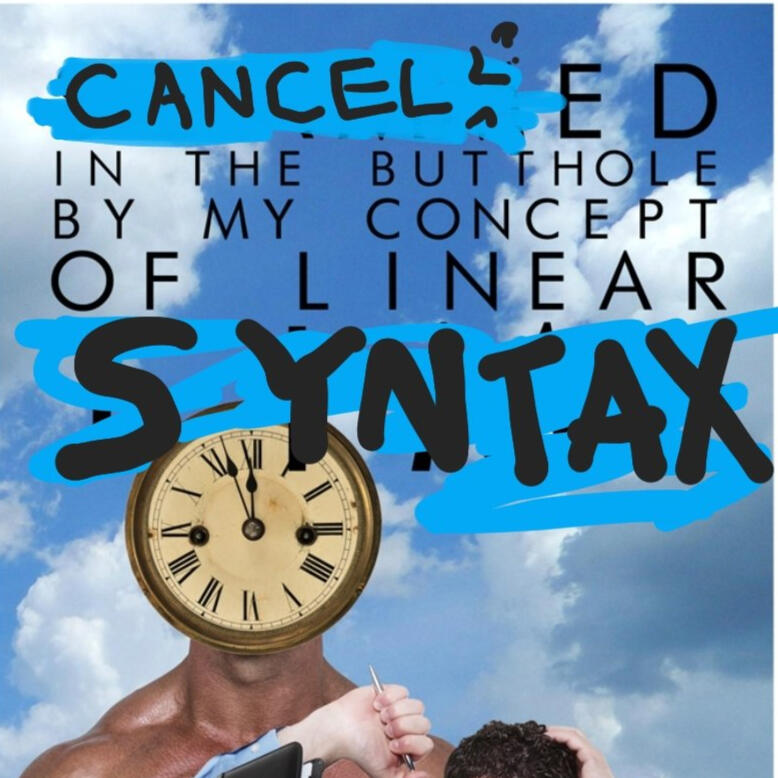
I have devoted my entire academic career since this first became a thing a few weeks ago to uncovering the cause of this unpleasant effluence of free speech and I can reveal that in 100% of cases, free speech is directly caused by speech. Also, writing is the number one cause of letters. I propose that we immediately move to ban orthography, phonetics and phonology. Actually, semantics and pragmatics are bad too. Syntax can stay, it’s mostly trees and I like trees. Trees are good.
Title: A Logical, Universal and Measured Response to Green (2020) and Meekings (2020)
Author: Michael Dow @mcdowlinguist
Publication date: July 15, 2020
Green (2020) and the subsequent response of Meekings (2020) have recently revived the debate over free speech and its importance in lingustics. The former advocates for a complete ban of free speech, citing, among others, the subjectivity of giraffoid aesthetics, while the latter critiques this approach as ineffectually limited, citing speech to be the root cause and therefore the more worthy object of suppression.
What these two authors fail to take into account is that I am an important man and they are not; therefore, my speech is not only important but also more important. While I concede the point of Meekings (2020) that it is crucial to distinguish between free speech and speech, I would add that neither are the true enemy but rather free free speech. Without book royalties, talk commissions and Elsevier, free speech is not lucrative and therefore I, an important man, could not make a living speaking freely. (NB: I already pinky swore with Joe Rogan that I wouldn’t step on his toes.) Also, the Enlightenment.
In conclusion, given their contents and intentions, I am not surprised that these articles have triggered heated discussion within the field. Though I do not support their interpretations, and though I do not recognize their names, I firmly support the authors as fellow scholars and express my admiration for their belief that anything will change.
Title: On Broviation
Author: Prof. Dr. @schnitza_fars
Publication date: July 16, 2020

To broviate is to use one’s academic credentials in a legitimate field to lend credence to alt-right falsehoods by misconstruing facts deliberately, loudly, and at great length in popular press books, TED talks, blog posts, and on social media. A well-known subspecies of broviation -- hood-pinking, or hood-pinkering, depending on the dialect -- involves using one’s academic credentials in one legitimate field to broviate in a second, third, or even fourth (possibly unrelated) field.
Like the term “mansplaining,” the canonical case of brovation involves the gendered behavior of cis, white, high-SES males whose status, and thereby platforms, are rooted in their excess of self-confidence and narcissistic impressions of their own urgent relevance. But anyone with enough chutzpah can broviate, as long as they have the financial and career security to shield them from the usual consequences of being an asshole.
Relevant to the study of langauge is the examination of broviation in the broader context of discourse and turn-taking. Broviators exhibit a fascinating pattern of turn-taking: their conversational moves are as frequent as possible, come as quickly as possible, and are as long as possible (280 characters in the case of tweets, sometimes involving copious abbreviations, despite abbreviating with periods, which are also a character). They are frequent interruptors, and have occasionally been known to utter the self-falsifying “I'mma let you finish” when interrupting.
We have, at this time, no suggested counter-measures to broviation, formal or otherwise, as earnest and well-researched open letters with hundreds of signatories have recently been shown to be utterly ineffective, and broviators’ advice — to tone down hostility and smile more, especially in the face of lies and bigotry — hasn’t worked for decades.
Title: Things I Wish They Said
Author: Angelica Hill she/her @WhhatDuYuMean
Publication date: July 16, 2020
I wish my first introduction to formal linguistics wasn’t, “You know, you’re first Black woman I’ve seen pursue formal semantics.” I wish I hadn’t been presented with the question, “Are you sure you want to go into this?” Now, here I am about to start my PhD and I am presented with letters; publications written by famous scholars for the whole outside world to read. I wish they had said that Linguistics is changing; that the people who do Linguistics are changing. I wish they had said, “We see the change and know we have to reconsider who best represents the field; who best represents the new Us.” I wish they had said, “Don’t be afraid to speak up, to grieve, or to protect. We won’t blacklist you.” I met this field with arms wide open, will it open its arms to me?
Title: Free speech? Whatever happened to Nice Speech?
Author: Shellie Fieldbloom
Publication date: July 16, 2020
Because it appeared in our revered flagship Jorunal, I was forced to read the works of Green (2020), Meekings (2020), and Dow (2020). I must object to the tone and timbre of this discussion, and of all discussions. It is altogether unbecoming of the field of Lingusitics, which is and always has been a paragon of civility.
As a strict neuro-computational superformalist (Fieldbloom 1995), I don't really pay attention to the content of what is said; I just focus on how it is said. My cursory skimming has revealed incontrovertibly that this discussion does not fit the universally accepted definitions of collegiality.
I won't weigh in on the controversial topic of whether speech is Good or Bad. I think it's more important that we all agree everyone has good intentions and no one has racist bones.
Thread: An anthropologists's perspective on "Cancel Culture"
Author: Jonah S. Rubin @js_rubin
Tweeted: July 15, 2020
Republished with permission
1/ Hi. I’m a cultural anthropologist. Can we talk about the “culture” part of #CancelCulture?
2/ A lot of talk about #CancelCulture focuses on whether “cancelling” is a real phenomenon, whether it’s new, and whether it is il/liberal. But few have asked the question, why call cancelling a culture? So let’s revisit Anthro101
3/ The term culture is notoriously difficult to define, doubly so for modern anthropologists who are often reluctant to use the much-critiqued word. (Spoiler: the reason anthros avoid it is the reason critics of #cancelculture use it).
4/ But as a starter, let’s go with the classic (and problematic) definition from Tylor that culture is a set of customs, beliefs, symbols, & habits associated with a given social group.
5/ Let’s add, a la Geertz, that culture is “arbitrary.” That is, there is no logical reason why French people wear berets and Scots wear kilts. You are born into a society that already has ideas of proper tastes, behaviors, rituals, and morals.
6/ In classic anthropology, culture is singular. The colonial anthropological project was to describe the singular cultural beliefs, practices, and symbols that defined “the Nuer” or “the Cree.” Internal debates, historical change, or differences w/i a culture are glossed over.
7/ These classic analyses of so-called “primitive culture” always also drew a contrast with the “civilized” Euro-America. While Europeans might “have” cultures, the idea was that “our” worlds were governed by rational debate whereas “they” were reflexively adhering to culture
8/ What does this divergence into Anthropology 101 reveal about #CancelCulture? First, the term #CancelCulture is only seriously used by critics. It allows them to draw together diverse calls for accountability under a single heading.
9/ So you no longer have to worry about why you are pissed off about Rowling’s transphobia, confederate monuments, or a non-diverse curriculum. No specific call for accountability can matter because they are all just really derivative of a larger #CancelCulture.
10/ (The idea that you might find Shor’s firing problematic but still not want to buy Goya products after their CEO endorses a racist and xenophobic President doesn't compute. No individual call for accountability can have its own logic since cultures must be analyzed as a whole)
11/ Moreover, by labeling calls for accountability as #CancelCulture, critics implicitly are saying that activist's commitments are ultimately arbitrary and non-rational, guided by an arbitrary generational "culture."
12/ Why do Brits like tea and crumpets? There’s no reason, that’s just what it means to be a Brit. Why do Millennials and Gen Zs like to “cancel”? There’s no reason, that’s just what their group does.
13/ Ironically, then, dismissing cancelling as a “culture” allows critics to not engage with the actual substance of calls for accountability. If it’s a culture, there cannot possibly be reasons behind their desire to hold people accountable.
14/ Side note: Look how often critics of #CancelCulture label their opponents as being a “mob” rather than a movement. A “mob” works off passions and emotion, whereas a movement is an organized effort to change society.
15/ And, by labeling calls for accountability as “culture,” critics draw the same kind of civilizational contrast as early anthropologists. They (often BIPOC) are governed by reflexive culture whereas we (often white) uphold the principles of free speech and rational debate.
16/ This is also why so many Defenders of Free Speech™ don’t see the rank hypocrisy of their own attempts to "cancel" those they don't like.
17/ Cary Nelson working to get @stevesalaita fired for his views on Palestine or Pollitt’s attempts to blacklist trans journalists can’t be #CancelCulture. Because their actions are governed by culture, whereas ours have reasons.
18/ As conservative @DouthatNYT recognizes, almost everyone believes there are limits on acceptable discourse and limited space on oped pages, museums, curriculums, etc. The real debate is about what those limits are & which voices should be prioritized.
Opinion | 10 Theses About Cancel Culture
19/ But none of those debates can actually happen if you believe that calls for accountability are part of an irreflexive, generationally-bound, arbitrary, non-rational #CancelCulture
Addendum: See the better #THELETTER for a more thorough critique of the cancel part of #CancelCulture
A More Specific Letter on Justice and Open Debate
Submission portal
Submissions will undergo a rigorous review process whereby we decide whether or not they fit with the Jorunal's goals and mission statement.
Appropriate manuscripts will be published upon acceptance.